
Views: 0 Author: Site Editor Publish Time: 2026-07-05 Origin: Site


Moving heavy materials safely requires more than basic raw strength. You need the exact equipment tailored to your specific physical environment. Relying on improper tools creates massive operational bottlenecks daily. Choosing the wrong transport mechanism leads to severe back strains, damaged inventory, and significantly slower workflows. Many operators consistently underestimate how simple factors impact overall handling efficiency. Frame geometry and wheel type drastically alter the physical exertion required.
Selecting an optimal unit goes far beyond checking basic weight ratings. You will learn how to accurately match equipment capacity to your strict operational demands. We will explore critical material trade-offs, structural designs, and necessary ergonomic features. You will discover specialized equipment designed for navigating highly complex terrain. This comprehensive guide gives you the technical knowledge required. It ensures you make a confident, safety-focused equipment decision.
Identify the geometry of your load: 2-wheel upright trolleys suit stacked boxes and appliances; 4-wheel flat dolly carts are required for bulky, asymmetrical loads.
Match material to environment: Aluminum reduces user fatigue for delivery routes, while welded steel is mandatory for static, heavy-duty warehouse operations.
Prioritize wheel selection: Terrain dictates caster choice—pneumatic for uneven surfaces, polyurethane for smooth concrete.
Understanding structural differences serves as your critical first step. It filters your options effectively. Misaligning your tool with the actual load type causes massive inefficiencies. It remains the primary source of daily workplace friction. You must evaluate the core mechanics behind each base design.
A standard Hand Trolley utilizes basic physics to function. It relies heavily on vertical mechanical leverage. The operator slides a bottom nose plate under the target item. They then tilt the main axis backward toward their body. This shifts the item's center of gravity directly over the wheels.
Optimal Use: They excel at moving neatly stacked cartons. They easily transport tall appliances. They navigate narrow aisles seamlessly.
Limitations: The primary drawback involves continuous balance. The operator must manually stabilize the load weight during entire transit paths.
Common Mistake: Users often stack items higher than the top frame handle. This creates an immediate tipping hazard. It obscures forward visibility entirely.
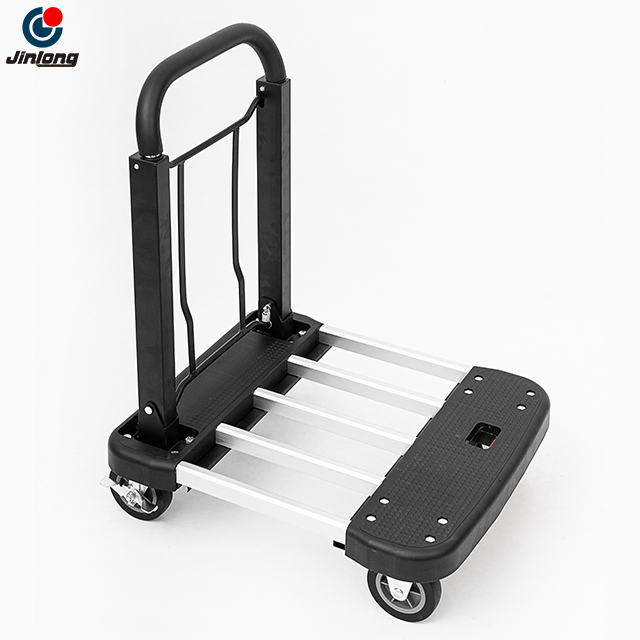
A classic Dolly Cart operates on entirely different mechanical principles. It features a flat horizontal platform mounted over four casters. It relies purely on horizontal push or pull force. It offers zero vertical leverage assistance.
Optimal Use: They remain essential for oversized, bulky furniture. They handle exceptionally wide loads effortlessly. They accommodate heavy asymmetrical items perfectly.
Limitations: They suffer from poor overall maneuverability over door thresholds. They cannot traverse steps easily. They lack built-in load-securing back support.
Best Practice: Always position the heaviest section of an asymmetrical load directly over the rigid rear casters. This improves steering control significantly.
Evaluation Criteria | Hand Trolley (2-Wheel) | Dolly Cart (4-Wheel) |
|---|---|---|
Load Mechanism | Leverage and tilt support | Direct horizontal pushing |
Vertical Stability | High (built-in backplate) | Low (requires straps) |
Threshold Navigation | Excellent | Poor |
Footprint Size | Compact vertical profile | Wide horizontal platform |
Capacity limits must perfectly align with your maximum anticipated load. You should never purchase equipment based on an average load calculation. Exceeding continuous working load limits compromises the main frame integrity quickly. It also degrades the wheel bearings under pressure.
Industrial settings represent demanding, high-cycle environments. They require extremely rigid construction standards. Fast-paced fulfillment centers cannot afford unexpected equipment failure.
High-cycle operations strictly require fixed, non-folding structural joints. They demand heavily reinforced solid axles. A proper warehouse trolley typically handles capacities easily exceeding 500 lbs. Look carefully for continuous handle loops in the design. These specialized loops allow simple one-handed operation. This becomes vital when operators must simultaneously open doors or scan inventory barcodes. Furthermore, look for easily replaceable wear parts. Replaceable skid runners and bolt-on wheel brackets extend operational life drastically.
Home relocations present an entirely different usage profile. They involve very low-cycle frequency but highly variable load geometries.
A high-quality moving trolley often features a highly adaptable, convertible design. They transform seamlessly from two upright wheels to four flat wheels. Foldable storage capabilities help you save valuable truck space. They fit neatly into standard car trunks between uses.
However, you must evaluate folding mechanisms with extreme caution. Scrutinize the stated load limits on these consumer hinges. A folding cart claiming a 300 lb maximum capacity will likely experience severe hinge flex. If you repeatedly load it to that maximum threshold, the joints weaken rapidly. Always audit folding mechanisms for thick locking pins and solid metal brackets.
Marketing materials routinely oversimplify frame components. You must evaluate options based entirely on harsh environmental realities. The specific material dictates both durability and operator fatigue levels.
Tubular steel provides the highest possible tensile strength. It typically boasts the lowest upfront manufacturing cost. It remains highly durable against blunt impacts. However, steel carries a heavy empty weight. This extra mass tires out operators faster over long distances. It also remains susceptible to corrosive rust in damp environments. You must maintain the powder-coated finish carefully.
Extruded aluminum offers a completely rust-proof alternative. It weighs up to 30% less than equivalent steel models. This weight reduction makes a massive difference during daily delivery routes. While aluminum commands a higher upfront cost, its failure mode differs safely. Extreme overload causes aluminum to bend gradually. Steel tends to snap suddenly at the welded joints when compromised.
Wheels serve as the primary contact point. They dictate rolling resistance and shock absorption. Selecting the wrong tire material guarantees poor performance.
Wheel Type | Primary Benefit | Core Trade-Off | Best Environment |
|---|---|---|---|
Pneumatic (Air-Filled) | Superior shock absorption | Puncture risk; requires air maintenance | Gravel, outdoor terrain, uneven concrete |
Solid Rubber (Flat-Free) | Zero maintenance; puncture proof | Heavier; transmits vibration to hands | Indoor floors with sharp metal debris |
Polyurethane Casters | Non-marking; extremely low rolling resistance | Struggles over cracks or loose dirt | Smooth polished warehouse concrete |
Standard models fail miserably under highly specialized handling scenarios. If your routine operations involve steep stairs or oversized industrial goods, standard criteria must shift immediately. You cannot rely on basic two-wheel designs for hazardous transit paths.
Transporting heavy loads up or down stairs represents a massive injury risk. Traditional wheels drag aggressively against the stair riser. They jolt the operator violently with every single step. A manual Stair Climbing Hand Trolley solves this precise issue. It utilizes a unique tri-star wheel cluster mechanism. Three distinct wheels mount onto a rotating central hub.
As you pull backward against a stair, the entire cluster rotates upward. It smoothly traverses the step edge without dragging the rigid axle. When evaluating these specific units, you must assess cluster clearance.
Oversized industrial goods demand extreme structural reinforcement. A standard frame will warp under the localized pressure of an engine block. When moving vending machines, safes, or large white goods, a true Heavy Duty Hand Truck becomes strictly necessary.
These specialized units feature double-welded steel frames. They utilize vastly thicker gauge metal. They include dual hand-grips for necessary two-handed control during tight turns. They feature significantly extended nose plates to support deeper items safely.
During evaluation, verify specific load-securing features. These trucks must feature integrated load-securing straps or built-in ratchet systems. They should include rear stair climbers or synthetic skid bars. These skid bars slide smoothly over curbs, maintaining tipping stability during steep transitions.
Final equipment evaluation always runs through the lens of operator safety. Workplace physical compliance remains mandatory for any commercial facility. Ignoring ergonomic guidelines predictably leads to costly worker compensation claims.
Look carefully for advanced ergonomic grip features. Continuous P-handles allow operators to control heavily loaded carts securely with just one hand. This prevents awkward shoulder twisting when navigating through swinging doors. Kick-bars located near the bottom axle drastically reduce operator strain. Operators simply press their foot against the kick-bar to initiate the backward tilt.
Selecting compliant equipment minimizes the initial push and pull force required to start movement. Industry safety frameworks emphasize reducing starting friction. Ensure your chosen caster size matches the floor surface properly. Larger wheels roll over small obstacles much easier, minimizing abrupt stops. Small, hard wheels sink into soft asphalt, instantly multiplying the required pushing force.
Follow this precise evaluation sequence to finalize your equipment decision:
Audit the heaviest item routinely moved: Identify the absolute maximum weight you expect to handle during a standard month.
Add a strict 20% safety margin: Multiply that maximum weight by 1.2. Use this final number as your absolute minimum target capacity.
Define the primary floor surface: Document whether you operate on smooth polished concrete, rough outdoor gravel, or carpeted stairs.
Select fixed versus folding: Choose based strictly on your realistic storage space availability and required daily usage frequency.
Purchasing the correct material handling equipment requires moving far beyond basic load capacities. You must evaluate exact environmental fit, user ergonomics, and core structural durability. Prioritize welded steel or lightweight aluminum models featuring easily replaceable wear parts for high-intensity environments. Prioritize space-saving, convertible designs for home or occasional relocation use. Always maintain a clear understanding of maximum hinge tolerances on folding models. Make your final selection based on your heaviest, most difficult typical load shape. You will effectively minimize daily physical strain and maximize long-term equipment lifespan.
A: Consumer-grade folding models generally handle 150–200 lbs safely. Commercial aluminum models handle a robust range from 400–500 lbs. Industrial heavy-duty steel trucks easily exceed 800 lbs of carrying capacity. You must always refer directly to the manufacturer's specified continuous working load limit before loading.
A: Pneumatic wheels prove vastly superior for uneven ground, rough gravel, or outdoor use. They provide excellent natural shock absorption. Solid flat-free wheels perform much better in controlled indoor environments. They roll perfectly on smooth floors and completely eliminate the high risk of sharp debris punctures.
A: No. They serve entirely different logistical purposes. A flat cart focuses on horizontal transport of wide, bulky items. It provides zero vertical load support. An upright truck remains strictly necessary for leveraging tall, stacked boxes and physically tilting them backward safely for transit.
A: Yes. Manual tri-wheel cluster designs significantly reduce the physical impact of pulling heavy loads up steps. They prevent axle dragging. However, for loads exceeding 200 lbs on steep stairs, a motorized climbing unit remains highly recommended. It guarantees maximum operator safety and prevents severe shoulder strain.


