
Views: 0 Author: Site Editor Publish Time: 2026-11-15 Origin: Site


The hidden cost of material handling often lies right under our feet. Specifying the wrong caster layout on a commercial cart leads to ergonomic strain. This mistake causes load instability and decreases operational throughput. Material, deck size, and load capacity usually get the most attention during purchasing. However, the exact configuration of swivel and fixed wheels dictates the physical effort required. It determines whether a cart needs 10 lbs or 40 lbs of human force to maneuver.
This comprehensive guide breaks down the physical mechanics behind different wheel arrangements. We will explore common layout categories for various industrial environments. You will learn a clear decision framework. This helps you specify the right wheel configurations for commercial and heavy-duty environments.
Straight-Line Tracking vs. Tight Maneuverability: Fixed wheels provide directional stability for long corridors; swivel wheels allow for 360-degree pivoting in confined spaces.
The Standard 2x2 Layout: Placing two swivel casters at the handle (push end) and two fixed casters at the front is the industry standard for optimal steering control.
Wheel Size Matters: Larger caster wheels generally roll more easily and cross thresholds better than smaller ones, directly impacting the pushing force required.
Application Dictates Design: A standard four-wheel folding hand truck requires a vastly different wheel layout than a heavy-duty manufacturing cart operating on uneven concrete.
Caster layout directly correlates to operator fatigue. Improper layouts create the dreaded "shopping cart syndrome." The cart drifts uncontrollably during transit. The operator must make constant course corrections to keep it straight. This wastes human energy. It also heavily risks musculoskeletal injuries. A well-designed Platform Truck leverages push physics. It aligns the operator's pushing force directly with the direction of travel.
Dynamic loads shift constantly during transit. When you turn corners rapidly, inertia pulls the cargo outward. A heavy-duty foldable trolley must maintain its center of gravity. Proper wheel placement prevents catastrophic tipping under heavy stress. Corner-mounted fixed casters stabilize the rear footprint. This design keeps heavy loads planted firmly over the axles. Operators can navigate turns safely without losing balance.
You must address the crucial trade-off between aisle width and turning radius. Tighter warehouse aisles demand specific layouts. They require prioritizing zero-degree turning capabilities over long-distance tracking. Long corridors benefit heavily from straight-line stability. You must evaluate your specific floor plan. A layout working beautifully in a vast factory often fails in a cramped stockroom.
Many buyers ignore their facility's physical constraints. They buy carts based solely on weight capacity. They forget to measure narrow aisle turning requirements. This oversight forces operators to drag loaded carts sideways. Dragging causes immediate wheel damage. It also strains the operator's lower back severely.
Understanding the mechanical differences helps you choose correctly. Each wheel type serves a distinct operational purpose.
Swivel casters utilize a raceway mechanism. They rotate 360 degrees freely on a central axis. They are absolutely essential for sharp turns. They handle lateral movement easily. You need them for navigating tight, restricted spaces.
However, they have distinct drawbacks. They remain highly susceptible to "caster flutter" at higher speeds. They wobble violently if poorly manufactured. Excessive side-thrust loads increase the risk of bearing failure. They require regular lubrication to function smoothly.
Manufacturers weld or stamp fixed casters securely. They sit in a fixed, forward-facing position. They offer unmatched straight-line tracking. They boast a significantly higher load-bearing capacity. Fewer moving parts make them highly durable in harsh environments.
Their main disadvantage is inflexibility. They provide zero lateral maneuverability. If you drag a loaded cart sideways, you damage the wheels. It also scars your facility's floor surface deeply.
Swivel vs. Fixed Caster Attributes
Feature | Swivel Casters | Fixed Casters |
|---|---|---|
Turning Radius | Full 360-degree rotation | Straight line tracking only |
Load Capacity | Moderate capacity | Maximum capacity |
Straight Tracking | Poor (drifts easily) | Excellent |
Maintenance Needs | High (requires bearing grease) | Low |
Buyers often confuse these two industry terms. The "wheel" is strictly the rolling element hitting the floor. The "caster" includes the entire rig and mounting hardware. Decision-makers must evaluate both parts carefully. The swivel rig quality dictates rotation smoothness. The wheel tread material determines floor protection and grip.
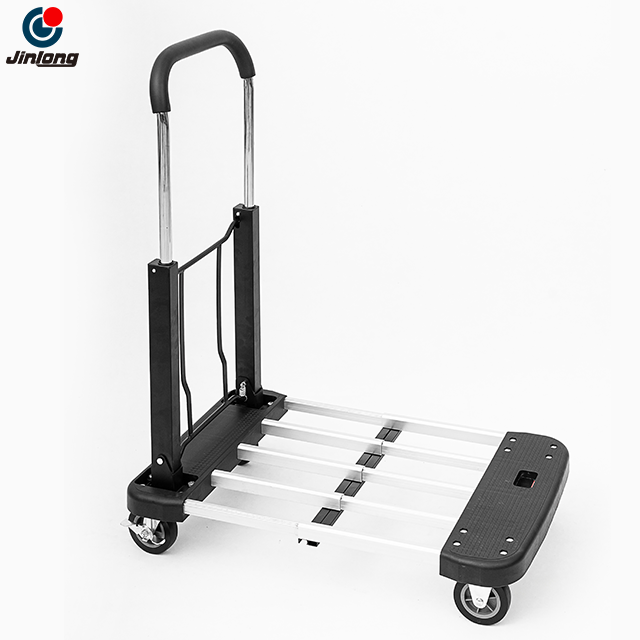
Industry standards rely on four primary layout configurations. Each solution fits a specific use case perfectly. We break down the mechanics and limitations for each below.
General-purpose material handling suits this setup best. It works flawlessly for long pushes. Standard warehouse operations rely on this design. It steers exactly like a car. The operator pivots the rear casters. This action directs the fixed front wheels smoothly. This remains the most popular layout for any standard platform truck. It balances control and maneuverability perfectly.
Extremely confined spaces benefit from this design. Operators use it for complex lateral "crabbing" movements. You can push it perfectly sideways into tight storage bays.
However, it has severe limitations. It is extremely difficult to push in a straight line. Uneven floors exacerbate this problem greatly. It causes high operator fatigue over long distances. Operators constantly fight the cart's natural tendency to drift sideways.
Heavy industrial loads require pivoting on a center axis. This diamond layout excels here. The center fixed wheels are slightly larger than the end wheels. They allow the truck to teeter slightly on the center axis.
This offers the absolute tightest turning radius. Oversized carts maneuver easily using this teeter-totter effect. Operators can spin massive loads in place. It requires a flat, balanced floor for optimal safety.
Pulling applications often use this setup. Tow-line carts rely on it exclusively. A mechanical tugger pulls the front swivel wheels.
Its limitations for manual use are severe. It creates a dangerous "rear-steer" effect if pushed manually. This makes it highly counterintuitive for human operators. It becomes hazardous for manual pushing. You must only use this layout when pulling the load from the front.
You must evaluate your operating environment before purchasing. Proper evaluation prevents premature equipment failure.
Floor types dictate the need for fixed tracking wheels. They also determine the ideal wheel diameters.
Smooth epoxy floors: These handle small, hard wheels easily. They offer low rolling resistance.
Cracked concrete: This demands larger, shock-absorbing wheels. Polyurethane treads work exceptionally well here.
Threshold gaps: These require fixed tracking wheels. Fixed wheels cross gaps without twisting sideways and getting stuck.
Floor debris: Debris requires softer tread materials. They reject metal shavings rather than embedding them.
You must understand incline physics for warehouse safety. Four-swivel configurations are highly dangerous on ramps. Operators lose directional control almost instantly. Gravity pulls the swiveling cart sideways down the slope.
Fixed wheels provide necessary anchoring. They keep the cart tracking straight during downhill braking. Safety protocols demand at least two fixed casters on any ramp. This prevents runaway carts from injuring personnel.
Starting resistance is the force required to begin movement. Heavier loads on swivel casters require higher initial force. Operators must align the swivel wheels first. They must force the wheels straight before the cart moves forward. This alignment lag causes immediate back strain.
Fixed wheels eliminate this dangerous alignment lag. They point forward constantly. You require significantly less force to initiate movement. Ergonomists recommend fixed front wheels for heavy starting loads.
Directional locks offer an excellent hybrid solution. Operators can lock swivel casters into fixed positions manually. This helps tremendously during long hauls down straight aisles. When they reach tight assembly areas, they unlock them. This restores full 360-degree rotation immediately. This upgrade bridges the gap between stability and maneuverability.
Purchasing the wrong configuration introduces massive operational risks. Maintenance teams struggle with improper fleets.
Sourcing replacement casters presents a serious maintenance challenge. Mixing caster heights can unbalance a cart entirely. Even a quarter-inch height difference causes premature wear. The cart will wobble constantly.
Mixing brands often alters the turning dynamics. You must replace casters in pairs or complete sets. Always verify the mounting plate dimensions. Measure the bolt hole spacing precisely before ordering parts.
Buyers must audit their facility layout thoroughly first. Measure your narrowest aisle width precisely. Note the primary floor type in your loading zones. Calculate the average daily travel distance per operator.
Do this before ordering an entire fleet. A standard four-wheel folding hand truck requires specific wheel configurations. Match the wheel layout to your exact material handling needs. Do not guess the required specifications. Consult your warehouse managers and daily operators.
There is no universal "best" caster layout. You must find the most mathematically and ergonomically sound layout. It must fit your specific operational footprint perfectly. We highly recommend the two swivel (rear) and two fixed (front) configuration. It serves as the safest baseline for most standard facilities. We also suggest integrating directional locks for unique hybrid needs. Please match your caster load ratings and layouts to your daily workflows carefully. Analyze your routes today to improve operator safety tomorrow.
A: You should place swivel wheels on the back (handle side) for pushing control. This steers the cart like a car. Place them on the front only for pulling or towing applications.
A: Yes, you can convert them easily. You must ensure the mounting plate dimensions match exactly. Be aware that this will drastically alter the cart's handling dynamics and straight-line tracking.
A: It likely features four swivel casters. This causes the cart to drift sideways. It could also have an insufficient wheel diameter for your rough floor surface, causing high rolling resistance.
A: Yes. Larger wheels lower rolling resistance significantly. They roll over obstacles and debris much easier. This reduces the required push or pull force, minimizing operator fatigue.


