
Views: 0 Author: Site Editor Publish Time: 2026-08-21 Origin: Site


Selecting the exact metal for your transport equipment represents a major operational decision. You are not just expressing a personal preference. This structural choice directly impacts daily worker fatigue and long-term replacement frequency across your supply chain. Manufacturers have radically advanced the modern folding cart recently. They incorporate innovative hinges, reinforced joints, and aerospace-grade materials. Despite these upgrades, the fundamental trade-offs of base metallurgy still dictate overall performance. You must constantly weigh structural lightness against raw tensile strength. This holds true across diverse commercial and industrial environments.
Deciding between aluminum and steel demands a highly strategic perspective. You need to align specific material limitations with your unique payload profiles. Carefully evaluate local environmental conditions and your planned deployment scale. Mastering this balance ensures you build a resilient, highly efficient logistics fleet. You protect your operators while maximizing daily transit productivity.
Aluminum prioritizes ergonomics and corrosion resistance, ideal for frequent, off-site delivery routes and maritime/damp environments.
Steel delivers superior tensile strength and impact resistance, suited for heavy-duty, stationary warehouse applications where sheer load capacity dictates value.
Folding mechanisms (hinges, locking pins) are the universal point of failure in any foldable hand truck; material choice impacts how these joints handle shear stress over time.
Fleet managers must calculate total ROI based not just on upfront cost, but on lifespan, maintenance requirements, and worker compensation claims related to equipment weight.
We need to establish robust success criteria first. A commercial-grade cart must provide precise load limit accuracy. It needs solid wheel base stability across uneven terrain. The folding mechanism integrity matters greatly for daily operations. You face a constant portability versus durability trade-off. Engineering realities dictate this physical balance strictly. Decreasing material weight naturally increases daily portability. However, doing so usually requires larger structural volumes. Alternatively, you might sacrifice peak load capacity entirely.
You must assess your exact working environment accurately. Climate variables dictate your initial shortlist heavily. High humidity alters your available options quickly. Salt exposure accelerates degradation on vulnerable frames. Flooring types also impact your physical choice. Rolling heavy loads over smooth concrete differs entirely from moving across loose gravel.
Furthermore, you must consider vehicle storage constraints closely. A bulky frame might not fit a compact van. Space efficiency remains critical for fast-paced delivery teams. Choosing the ideal Foldable Hand Truck requires mapping these exact constraints. You cannot guess these variables safely. Gather data directly from your logistics teams. Analyze where the equipment spends most of its operational time.
Let us examine the specific traits of modern aluminum. Manufacturers typically utilize 6000-series aircraft-grade alloys for premium frames. This specific grade provides an exceptional strength-to-weight ratio. It allows the frame to remain highly rigid continuously. Meanwhile, it sheds unnecessary bulk completely.
You gain distinct operational advantages utilizing this metal. The substantially lower curb weight reduces operator fatigue significantly. Drivers lift the equipment repeatedly throughout the day. Getting it in and out of delivery vehicles becomes much easier. This agility speeds up the entire delivery route. Furthermore, aluminum develops a natural oxidation layer naturally. This microscopic chemical barrier prevents structural rust effectively. Thus, an Aluminum Foldable Trolley fits perfectly in specific niches. It thrives within sensitive food service operations safely. It also serves medical logistics exceptionally well. Coastal operations benefit from this inherent salt resistance immensely.
You must acknowledge the known physical limitations, too. Buyers face a higher upfront procurement cost initially. High-grade alloys demand premium manufacturing processes constantly. Additionally, the metal remains susceptible to surface denting. Repeated shock loads cause insidious metal fatigue over time. Dropping heavy boxes directly onto the toe plate accelerates wear. The material flexes differently than denser metals under heavy loads.
Here are common mistakes to watch out for:
Treating the lightweight frame like an indestructible pry bar.
Overloading the nose plate beyond the stated rated capacity.
Ignoring hairline cracks near the primary structural welding points.
Assuming the folding hinges share the exact same rust resistance.
Tubular carbon steel offers profoundly different material characteristics. The physical properties revolve around density and structural thickness. Gauge thickness determines actual performance in folding applications heavily. Thicker gauges resist bending under massive stress effectively. They form the absolute backbone of industrial logistics tools.
The operational advantages center entirely on raw physical power. Exceptional yield strength enables much higher static load ratings. Dynamic load ratings improve considerably during movement as well. High impact resistance serves as a defining feature here. A robust Steel Folding Trolley bends under extreme stress gracefully. It rarely snaps or cracks like rigid lighter alloys. This predictability prevents sudden catastrophic failures during transport. Furthermore, the lower initial procurement cost appeals to buyers. Raw steel remains highly affordable in global supply markets. Fleet-wide deployment becomes significantly more budget-friendly immediately. You equip more workers for less capital upfront.
However, steel brings notable operational limitations into play. The high baseline weight reduces ergonomic benefits drastically. Last-mile delivery scenarios magnify this physical burden consistently. Operators exert more effort just moving the empty cart. Rust presents another constant environmental challenge daily. Deep scratches expose the raw iron beneath the protective paint. A damaged powder-coated finish invites rapid oxidation quickly. Galvanized finishes suffer similarly if gouged deeply. Consequently, you must schedule proactive maintenance consistently. Teams must inspect frames for exposed metal frequently. Proper upkeep ensures the structural integrity remains totally uncompromised.
Material performance shifts dramatically when you alter geometry. Transitioning from an upright hand truck introduces new dynamics entirely. A flat 4-wheel platform design distributes weight horizontally instead. You must evaluate how different metals handle dispersed loads. The center of gravity changes completely in this configuration.
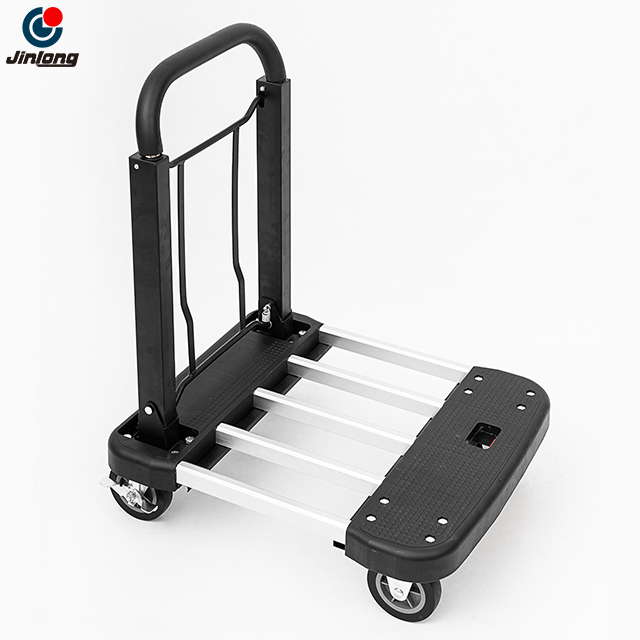
Consider the performance profile of an Aluminum Platform Trolley carefully. This design thrives deeply in clean-room environments. Office logistics teams prefer it heavily for daily transport tasks. It works brilliantly for urban transit routes specifically. Workers often carry the trolley up stairs manually. They perform this lift before deploying the wheels fully. The low base weight makes stair climbs highly manageable. It protects employees from severe back strain daily.
Conversely, you should examine the heavy-duty counterpart closely. A Steel Platform Trolley serves as the undisputed industry standard. Heavy manufacturing relies on this unyielding rigid base. Industrial warehousing demands maximum structural rigidity constantly. Constant forklift proximity introduces high collision risks daily. Heavy pallet transfers require a tough, unyielding flatbed. Steel absorbs these brutal daily abuses much better.
Joint vulnerability requires special engineering attention in platforms. Folding handle brackets endure massive lateral torque during sharp turns. Pushing heavy loads sideways stresses the hinges severely. Steel models generally survive this lateral torque better. Aluminum counterparts may warp under maximum weight capacity. You must factor this specific joint stress into planning. Choose the material that handles your heaviest steering forces reliably.
You need a clear matrix to frame the real lifespan value. Steel costs less initially but degrades faster in damp spaces. You might replace it sooner in corrosive maritime environments. Aluminum represents a strong investment in long-term operator ergonomics. You protect your workforce from chronic strain effectively.
The hinge stress test separates average carts from premium tools. Compare how both metals handle repeated shear forces carefully. The folding joints endure massive friction during daily collapses. We strongly advise inspecting the pivot pins closely. Sometimes an aluminum frame utilizes incredibly cheap steel pins. This oversight creates a high risk of galvanic corrosion. The incompatible metals react and rust from the inside out. This destroys the folding capability completely over time.
Matching material to tires completes the engineering package properly. Material choice should dictate your caster and wheel selection directly. Lightweight frames pair beautifully with soft pneumatic tires. The air-filled tires provide excellent shock absorption on uneven sidewalks. Conversely, heavy steel frames pair best with dense polyurethane. These hard wheels offer superior load bearing capacity indoors. They roll smoothly across flat warehouse concrete floors seamlessly.
Performance Criteria | Advanced Aluminum Design | Tubular Steel Design |
|---|---|---|
Initial Procurement Expense | Higher initial investment required | Highly budget-friendly option |
Ergonomic Load Burden | Low base weight, minimal fatigue | Heavy base, moderate fatigue |
Environmental Resistance | Excellent (Natural oxidation barrier) | Low (Requires powder coat seal) |
Extreme Impact Handling | Prone to surface denting and flex | High resistance, minor bending |
Optimal Deployment Environment | Coastal, transit routes, medical | Warehousing, heavy manufacturing |
Joint Torque Resilience | Moderate (Prone to lateral warping) | High (Exceptional shear strength) |
Deploying new equipment introduces distinct operational risks always. You must manage operator adoption proactively and carefully. Delivery drivers might abandon heavy steel carts quickly. The excessive weight makes long daily routes exhausting. This rejection negates your entire initial purchase investment entirely. You need equipment your team actually wants to maneuver. Ergonomics drive daily compliance in the field heavily.
Next, establish realistic maintenance protocols immediately upon delivery. Proper care extends the functional lifespan significantly.
Follow these core maintenance procedures:
Lubricate all folding metal joints and hinge pins monthly.
Inspect aluminum structural welds for hairline micro-fractures frequently.
Touch up scratched steel powder coats to prevent rust immediately.
Clean the wheel axles to remove trapped debris and strings.
Test the locking mechanism engagement fully before major heavy lifts.
Safety and compliance represent the absolute final hurdle. OSHA guidelines address manual pushing and pulling limits directly. The base weight of the equipment factors heavily here. A heavier cart leaves much less allowance for the payload itself. You must keep the total moving mass within stated safety guidelines. Ensure your material choices align perfectly with local worker policies. This protects both your dedicated employees and your daily operations. Ignoring these weight limits invites severe physical injuries.
Avoid declaring a universal winner between these robust metals. Each material excels clearly under very specific operational parameters. Steel clearly wins on pure load-per-dollar investment metrics. It guarantees survival against brutal, repetitive industrial impacts continuously. Meanwhile, aluminum dominates daily ergonomic efficiency perfectly. It provides vital corrosion resistance for sensitive wet environments. Transit-heavy applications benefit massively from its lightweight agility.
Your procurement teams should execute a limited pilot test next. Deploy one of each material into the active field simultaneously. Run this live operational test for a solid 30 days. Gather direct performance feedback from your daily operators. Analyze their practical experiences and physical fatigue levels carefully. Document how the hinges perform under real-world stresses. Use this empirical field data before executing any bulk purchase. Making an informed choice ensures long-term operational success.
A: You must distinguish between cosmetic denting and catastrophic structural failure. High-grade aluminum handles its stated weight capacities safely without bending. However, it dents more easily upon hard impacts. Steel absorbs those same sudden shocks without surface denting, though extreme overloads will bend it permanently rather than snapping.
A: Commercial folding mechanisms realistically support between 150 lbs and 500 lbs safely. The folding joint usually serves as the structural bottleneck. The base metal handles much more weight safely. However, hinges and locking pins dictate the absolute safe maximum capacity during transit.
A: Yes, steel requires protective finishing to prevent rapid oxidation entirely. Manufacturers apply powder coating or galvanization to seal the raw metal. You must perform regular maintenance using touch-up paint. Deep gouges expose the steel to moisture, inviting destructive rust quickly into the frame.
A: The aluminum frame naturally resists structural rust outdoors perfectly. However, permanent outdoor exposure remains highly inadvisable. Constant UV rays and moisture rapidly degrade the rubber wheels. Weather exposure also destroys plastic components completely and washes away essential joint lubricants over time.


