
Views: 0 Author: Site Editor Publish Time: 2026-08-17 Origin: Site


Mismatched material handling equipment drains your daily operations. Decreased throughput slows down delivery schedules and frustrates your team. Operator fatigue increases daily risk levels. Workplace injuries or product damage act as hidden operational costs. You need the proper tool for the exact task. While both manual tools move heavy loads, their differing physics dictate distinct operational environments. Tilt-and-leverage mechanics serve completely different physical needs compared to flat-pushing bases. This guide provides a strict, criteria-based evaluation framework. We help logistics teams and warehouse managers evaluate hardware effectively. You will learn the exact operational limits of each equipment type. By the end, you can make a confident, finalized procurement decision tailored to your facility.
Heavy Duty Hand Trucks excel in vertical stacking, tight turning radii, and navigating thresholds or stairs via leverage.
Platform Trucks are superior for bulky, asymmetrical, or high-volume horizontal loads over flat, even surfaces.
Storage constraints often dictate the choice; a Foldable Platform Trolley or Convertible Folding Hand Truck offers hybrid scalability for delivery vehicles and compact stockrooms.
The final decision rests on three primary metrics: average load footprint, route terrain, and operator ergonomics.
Equipment form factor dictates how human energy transfers into movement. You must understand these underlying physics to match the right cart to your operational workflow.
This upright tool operates on the principle of leverage. It acts as a Class 1 lever in physics. The axle serves as the fulcrum. The operator applies force at the handles, lifting the load resting on the nose plate.
It requires the operator to tilt and balance the load over two wheels.
Operators must maintain constant equilibrium during movement.
Performance Assumption: This tool works best when you can safely tilt the center of gravity toward the operator. It excels when carrying rigidly stacked, uniform items.
Common Mistake: Operators often attempt to move items wider than the wheel track. This shifts the center of gravity laterally, causing severe steering instability.
Flatbed carts rely on a completely different mechanical baseline. They operate on a stable, four-point or sometimes six-point wheeled base. They transform manual force entirely into horizontal momentum.
They require pushing or pulling. They demand absolutely no lifting or balancing from the operator once loaded.
The wide wheelbase naturally absorbs shifting weight.
Performance Assumption: This format performs best when the load is self-stabilizing on a flat deck. It thrives in open, horizontal spaces.
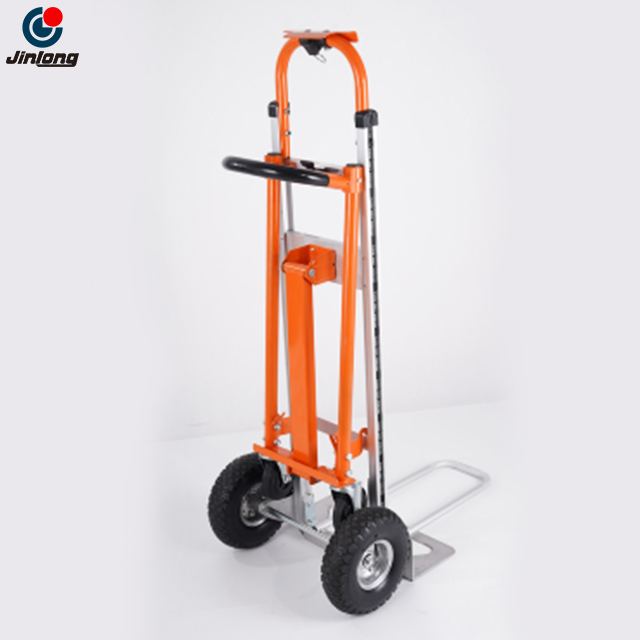
Warehouse managers evaluate tools based on success criteria. For the Heavy Duty Hand Truck, the primary success criteria involves fast transport of stacked, uniform items. You will often use it for moving boxes, beverage crates, or tall rigid items like appliances.
This two-wheel format dominates specific operational environments. They shine where space remains heavily restricted.
Maneuverability: They remain unmatched in narrow aisles. You can easily pivot them through tight doorways and crowded retail delivery routes.
Vertical Mobility: They easily navigate curbs, thresholds, and stairs. Specialized models often include stair-climber belts. These belts allow smooth descent over concrete steps without jarring the cargo.
You must acknowledge where this equipment fails. Pushing past these boundaries leads to product damage or worker injury.
Nose Plate Constraints: Load depth remains strictly limited by nose plate size. Overhanging loads create dangerous leverage imbalances. When boxes extend too far forward, the operator fights to keep the truck tilted backward.
Operator Fatigue: Constantly breaking back heavy loads requires significant physical exertion. Proper ergonomic training is mandatory. Workers can strain their lower backs if they pull with their spine instead of leveraging their body weight.
Best Practice: Always position the heaviest items at the bottom of the stack. This lowers the center of gravity and drastically reduces tilt effort.
Flatbed carts solve the problems that two-wheelers cannot handle. Their primary success criteria is moving wide, irregularly shaped, or sheer high-volume loads across large facilities. They accomplish this without requiring operator balancing.
These carts act as mobile foundations. They prioritize payload volume and horizontal stability.
Volume & Stability: Four wheels distribute weight evenly. This eliminates the need to balance the cargo. It significantly reduces operator strain over long warehouse distances.
Versatility: They easily accommodate specialized loads. You can stack sheet goods, long lumber, or loose parts in large bins. They adapt to nearly any flat-bottomed cargo.
Despite their payload capacity, these carts face strict environmental limitations. They demand specific facility conditions to function safely.
Terrain Sensitivity: Small, hard casters struggle heavily with uneven surfaces. They jam easily on debris, dock plates, or thresholds. This contrasts sharply with large pneumatic hand truck tires, which roll over gravel easily.
Spatial Footprint: A four-wheel cart requires wide turning radii. It consumes significant storage space when parked. Unless your team utilizes a Foldable Platform Trolley for lighter commercial tasks, you must dedicate floor space to park rigid models.
Making a fleet purchase requires structured analysis. Do not rely on weight capacity alone. Use these four evaluation lenses to finalize your procurement strategy.
Evaluation Lens | Two-Wheel Upright Design | Four-Wheel Flatbed Design |
|---|---|---|
Load Profile | Tall, stackable, depth under 20 inches | Wide, bulky, asymmetrical, deep footprint |
Route Terrain | Rough surfaces, curbs, stairs, thresholds | Smooth concrete, flat warehouse floors, long hallways |
Storage Reality | Minimal footprint, hangs on walls easily | Requires large parking zone (unless using folding models) |
Ergonomic Action | Tilt, balance, push/pull | Direct push, zero balancing required |
Load Profile (Weight vs. Dimensions): Look closely at dimensions, not just weight. A 1,000-lb capacity tool is completely useless for a 500-lb sofa that extends three feet past the nose plate. Assess the footprint of your most common cargo.
Route Terrain & Environment: Assess the exact path from point A to point B. Carpet, gravel, and rough thresholds favor large pneumatic wheels. Smooth concrete warehouse floors heavily favor hard, non-marking flatbed casters.
Storage & Transport Realities: For delivery drivers or retail backrooms, space carries a premium price. You must factor in where the equipment lives. Assess the deployment speed of folding mechanisms if utilizing delivery vans.
OSHA Compliance & Ergonomics: Evaluate the physical toll on workers. Pushing a Platform Truck generally results in fewer musculoskeletal complaints than tilting a heavily loaded two-wheeler. OSHA strongly recommends pushing over pulling to protect shoulder and lower back joints.
Sometimes a single-function tool cannot support your operational variability. Operations with highly unpredictable cargo profiles require flexible hardware.
A hybrid tool transitions seamlessly between two modes. It shifts from a standard 2-wheel configuration to a 4-wheel flatbed orientation. Operators usually press a release latch to drop the secondary frame into place.
A Convertible Folding Hand Truck fits perfectly in variable environments. Last-mile delivery drivers use them extensively. Mobile event teams and retail staff love them. When load profiles change daily, this tool adapts on the spot. You can move stacked boxes into a building, drop the frame, and haul a wide desk back out to the truck.
Versatility always comes with specific engineering trade-offs.
Mechanical Complexity: Moving parts introduce potential points of mechanical failure. Latches and hinges require routine inspection and lubrication.
Weight Penalty: They weigh slightly more than dedicated single-function units. The dual-frame construction adds extra aluminum or steel to the overall chassis.
You have reviewed the physics, constraints, and hybrid options. Now, you must apply these concepts directly to your facility.
Walk the exact path the equipment will take daily. Measure the narrowest pinch point. Identify the highest threshold or dock plate transition. If you encounter multiple stairs or heavy gravel, you immediately eliminate small hard casters from your list.
Identify the top 80% of items moved by volume and shape. Buy equipment for the rule, not the exception. If 80% of your movement involves small stacked cartons, buy upright units. Let two workers manually carry the rare bulky couch. Do not buy a massive flatbed just for occasional odd jobs.
Match your specific findings against exact manufacturer specs. Check caster material, nose plate depth, and frame metal (aluminum vs steel). Request a demo unit. Run a strict one-week floor test with your actual workers before approving a massive fleet purchase.
Proper equipment procurement directly impacts your bottom line. An upright two-wheeler acts as an extension of the worker. It leverages human mechanics for vertical, tight-space movement over dynamic terrain. Conversely, a flatbed cart provides a mobile foundation. It handles bulk, flat transport over smooth, long-distance routes. Assess your facility constraints carefully before ordering.
Ready to upgrade your warehouse logistics? Contact our sales team with your specific weight limits and terrain details. Review our specific product catalog pages for immediate technical comparisons and find the exact configuration your team needs today.
A: Not completely. While versatile, convertibles generally possess lower maximum weight capacities than dedicated industrial flatbeds. They also feature smaller deck sizes, limiting their ability to carry extra-wide or over-sized materials securely across long warehouse floors.
A: Pneumatic (air-filled) wheels excel on rough terrain. They absorb shock and roll easily over gravel or grass. Semi-pneumatic wheels offer similar benefits without flat-tire risks. Polyurethane casters are durable but belong strictly on smooth, hard indoor surfaces.
A: On a flatbed, place the heaviest items dead center to stabilize the wheelbase. You can use ratchet straps across the deck for irregular items. On an upright truck, place heavy items at the bottom against the frame, and secure tall loads using horizontal bungee cords or built-in strap ratchets.
A: Capacities vary drastically by design. Light foldable models usually handle between 300 to 500 lbs. Standard aluminum upright units hold around 500 to 800 lbs. Heavy-duty industrial flatbed carts easily support 2,000 lbs or more depending on their steel frame and caster ratings.


