
Views: 0 Author: Site Editor Publish Time: 2026-08-14 Origin: Site


Moving bulky items up a flight of stairs often feels like an impossible task. It severely pushes human physical limits and creates dangerous scenarios for anyone involved in the moving process. Without specialized equipment, ascending steps introduces immense physical risks. Operators routinely face severe physical injury, potential workplace compensation claims, and serious property damage. Improvised DIY methods fail quickly at scale. Sliding heavy boxes on cardboard or relying on dangerous "buddy-lifting" violates basic safety protocols every single time. Instead, your logistics team needs an engineered mechanical solution. We introduce the purpose-built trolley designed specifically to leverage physics. It successfully shifts the heavy burden of gravity from you directly to the equipment. This detailed guide provides a transparent, criteria-driven framework. You will learn exactly how to evaluate, select, and safely implement the right climbing trolley for any complex residential or demanding industrial application.
Mechanical Advantage: Tri-wheel and track-based designs distribute weight across stair treads, significantly reducing the physical force required to ascend or descend.
Safety & Compliance: Implementing a heavy duty hand truck lowers ergonomic risks and helps meet occupational safety standards (e.g., OSHA guidelines for material handling).
Selection Criteria: The choice between manual, motorized, rigid steel, or foldable units depends strictly on payload frequency, item dimensions, and operating environment constraints.
Cost vs. ROI: Upfront investment in commercial-grade climbing trolleys is offset by reduced labor times, fewer personnel required per job, and mitigated liability from dropped loads.
Standard equipment fails repeatedly on steep staircases. Traditional two-wheel dollies demand massive physical exertion from workers. The operator must bear the full weight of the payload constantly. During the pull-up phase over every single step, muscular strain multiplies rapidly. This constant lifting quickly leads to severe operator fatigue. Tired operators lose control of bulky items easily. A standard dolly simply cannot negotiate vertical obstacles safely. The wheels hit the riser harshly, causing the entire frame to bounce backward.
The tri-star wheel design solves this exact problem effectively. Manufacturers engineer these rotating three-wheel chassis systems specifically for stairs. The wheels maintain continuous contact during the entire climb. As one wheel hits the vertical stair riser, it stops moving forward. The entire assembly then pivots smoothly around the central axle. This rotation plants the next wheel firmly on the upper tread. You no longer lift the heavy weight yourself. The Stair Climbing Hand Trolley uses pure mechanical advantage to climb. It transforms a brutal vertical lift into a highly controlled rotational pivot.
Payload stability remains absolutely critical for fragile or awkwardly shaped goods. The pivot mechanism keeps the center of gravity perfectly stable. It prevents the load from bouncing abruptly between hard steps. Standard dollies violently jolt the payload on every single drop. Tri-wheel designs glide down steps in a carefully controlled arc. This smooth transition protects delicate internal components inside large appliances. It also protects you from sudden, dangerous weight shifts. Occupational safety organizations strongly recommend utilizing these mechanical aids. Repeatedly hauling weight up stairs violates basic ergonomic principles. By keeping the load grounded firmly on the stairs, you protect your spine completely.
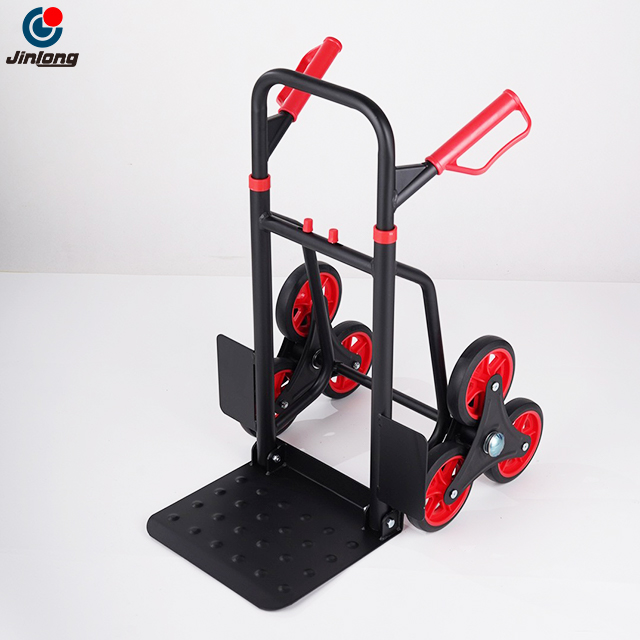
Manual stair climbers serve very specific logistical purposes perfectly. They work exceptionally well for intermittent use and lighter daily loads. If you move items weighing under 150 lbs, manual units excel. Budget-conscious operations often rely on these unpowered, lightweight frames. However, you must consider the physical demands involved deeply. A manual climber still requires significant human operator exertion. It relies entirely on your physical momentum and proper lifting form. You must pull the lever arm back firmly to find the balance point. Then, you pace your steps carefully to maintain a safe climbing rhythm.
Motorized or electric stair climbers tackle much heavier challenges. They suit high-frequency deliveries and commercial logistics operations perfectly. When moving extreme weights like steel safes or refrigerators, motors become essential. A motorized unit pushes the load up the steps automatically. Operators simply guide the balance and steer the frame. But you must manage battery life diligently throughout your shift. Most commercial units utilize heavy-duty lithium-ion or sealed lead-acid batteries. These units also carry a substantially higher upfront purchase price. Their base unit weight is considerably heavier due to the internal battery and motor housing.
Calculating your return on investment depends on labor and safety metrics. Consider your daily labor costs carefully. One operator can easily manage a motorized climber alone. Manual lifts often require two or three operators for basic safety. You also drastically reduce costly workplace injuries over time. Fewer injuries mean lower insurance premiums and better employee retention. When workers feel safe, they perform tasks more efficiently. We often see delivery times drop significantly after introducing motorized fleets.
Feature | Manual Climbers | Motorized Climbers |
|---|---|---|
Best Load Weight | Under 150 lbs | Over 150 lbs (up to 1000+ lbs) |
Operator Effort | High physical exertion | Low physical exertion |
Team Size Needed | 2-3 people for heavy items | 1 person usually sufficient |
Frequency of Use | Intermittent or occasional | High-frequency daily routes |
Base Unit Weight | Lightweight (Easy to carry) | Heavy (Requires ramp loading) |
Selecting the correct frame type guarantees safe daily operation. You must match the equipment exactly to your specific route environments. Consider the Foldable Hand Truck for excellent lightweight versatility. These units shine brightly during residential moves and parcel deliveries. Delivery drivers love them because they fit into tight spaces. You can easily slide one right behind a delivery van seat. However, they carry inherent structural limitations you must understand. They feature a significantly lower maximum weight capacity overall. Moving parts and folding hinges introduce structural vulnerabilities over time. Extreme stress can warp or snap these folding joints unexpectedly.
Industrial environments demand much stronger material handling solutions. The Steel Ladder Trolley provides absolute maximum structural durability. Warehouses and heavy-duty retail restocking operations require rigid, unyielding frames. A solid steel frame handles high torque without flexing at all. When operators pivot hundreds of pounds, the frame must remain stiff. Flexing frames cause heavy loads to shift dangerously mid-climb. Steel units survive daily abuse in brutal commercial warehouse settings. They shrug off impacts against concrete walls and metal door frames.
Vending machines and HVAC units require extreme carrying capacity. A Heavy Duty Hand Truck serves these appliance and industrial grades best. These robust models often feature much wider chassis frames. They include dual-strap tensioners to lock large items securely in place. Reinforced toe plates prevent bending under massive point loads. You must also account for spatial clearance constraints carefully. Heavy-duty models require wider staircases to function safely. They also need much larger landing areas for turning around corners. Always measure your tightest stairwell before deploying these massive tools. If the landing is too small, you cannot pivot the unit safely.
Equipment alone cannot prevent terrible workplace accidents. Proper execution requires extreme discipline and constant situational awareness. Operator training remains strictly non-negotiable across all industries. The tool successfully mitigates heavy load weight. It does not eliminate the need for proper human posture. Operators must maintain controlled pacing during every single climb. Rushing causes dangerous missteps and potential catastrophic backwards falls. Managers must observe drivers and correct poor posture immediately.
Proper load securing prevents sudden disaster on the stairs. Heavy items must be firmly ratchet-strapped to the rigid frame. Elastic cords are entirely insufficient for professional stair climbing tasks. A bouncing load easily snaps a weak elastic bungee cord. Once a load shifts, it pulls the operator off balance instantly. Secure strapping locks the cargo and the trolley together securely. They effectively become one solid, easy-to-manage unit. We recommend using straps rated for at least three times the payload weight.
We recommend strict protocols for inspecting the environment before lifting. A climbing trolley is only as safe as the stairs beneath it. Here are the vital surface assessment steps operators must take:
Check stair tread integrity for rotting wood or loose metal edges.
Test surface grip, comparing slick wet concrete against dry carpet.
Measure clearance angles to ensure the load can pivot at the landing.
Verify adequate lighting in the stairwell to clearly see every single edge.
Clear all debris, loose rugs, or cables from the entire travel path.
Going down stairs carries a much higher risk of injury. Runaway loads happen mostly during the tricky descent phase. Gravity pulls the mass downward rapidly. We must emphasize the absolute importance of built-in braking mechanisms. Motorized units use electronic brakes or track friction to slow descent. Manual operators must physically resist the gravitational pull themselves. Never underestimate the immense danger of descending steps. A slight slip can cause the payload to crush the lower operator.
Buying the right equipment requires strict attention to mechanical detail. You must evaluate specific mechanical criteria before making a purchase. Do not just buy the cheapest option available online. Look closely at how the manufacturer tests and rates their equipment. A failure on a staircase carries consequences far beyond a broken tool.
Verify True Weight Capacity: Never confuse flat ground capacity and stair climbing capacity. The stair capacity is often 30 to 50 percent lower. A frame holding 500 lbs on flat concrete might only safely pivot 250 lbs on stairs. Always check the secondary rating strictly for incline use.
Material Construction: Assess your material needs carefully based on your climate. Aluminum offers a lighter, completely rust-proof frame. It features higher flex under extreme loads. Steel provides heavier, maximum rigidity for industrial use. However, steel remains highly susceptible to rust if the paint gets scratched.
Wheel Composition: Solid rubber or polyurethane wheels perform best on stair treads. They prevent flat tires completely on rough job sites. They also eliminate bouncy pneumatic rebound during the pivot phase. You want a dead, solid feel when planting the wheel on a step.
Warranty and Parts Availability: Enterprise buyers must evaluate the manufacturer service level agreements. Replacement parts keep your commercial fleet moving profitably. Prioritize easy access to replacement batteries for all motorized units. Ensure you can quickly order replacement tri-wheel hubs when bearings eventually wear out.
Moving heavy goods upstairs safely requires an immediate operational transition. You must move away from brute force toward mechanical advantage. Base your equipment purchase strictly on your maximum intended payload. Evaluate your daily frequency of use rather than looking at baseline cost. An undersized trolley creates immediate safety hazards for your team.
Audit your most common delivery profiles today. Understand exactly what your drivers carry every single week. Measure your typical stair clearances in your standard delivery zones. Finally, request a detailed spec sheet or live demo for the appropriate heavy-duty or foldable unit. Protect your workers by providing the right physical tools for the job.
A: It depends heavily on the wheel material and payload weight. Non-marking polyurethane wheels generally protect hard surfaces very well. However, extreme weights can dent soft woods regardless of the wheel type used. Tracks on motorized units distribute weight much better. This wide distribution helps prevent point-loading damage on delicate residential stairs.
A: Motorized units often allow safe single-operator use for large appliances. The motor handles the lifting force entirely. However, manual units carrying over 100 lbs typically require a second person. This spotter should watch from below or guide the load from above. Spotters ensure safe maneuvering and prevent runaway descents.
A: Foldable units are excellent for light-duty, last-mile deliveries weighing under 150 lbs. They save valuable truck space. For industrial hauls or heavy appliances, they fall short. The hinges and collapsible joints become dangerous weak points under extreme stress. A rigid steel ladder trolley is absolutely required for safe commercial heavy lifting.
A: They work best on standard stair dimensions. This means approximately a 7-inch riser and an 11-inch tread. Irregular architecture causes problems. Spiral staircases, stairs with extreme overhangs, or very shallow steps can disrupt the pivot mechanism. Operators must measure unusual staircases before attempting a heavy lift to ensure safe wheel rotation.


